

In short: SEO (search engine optimisation) is the practice of improving your website so it ranks higher on Google for searches your customers actually make. For Australian businesses, it means showing up when someone in Sydney, Melbourne or Brisbane searches for what you sell – and earning that traffic without paying per click. Results typically build over 3-6 months and compound from there.
Last updated: October 2026.
If you have ever wondered why some businesses seem to own the first page of Google while others are invisible, the answer is usually SEO. Not luck, not paying Google under the table – just consistent, well-executed optimisation.
This guide explains what SEO actually is, how it works, and what it means for an Australian business in 2026. No jargon, no fluff.
What does SEO stand for?
SEO stands for search engine optimisation (spelled with an “s” in Australia, a “z” in the US). It is the set of practices that help your website appear higher in Google’s organic – meaning unpaid – search results.
When someone searches “plumber parramatta” or “best accounting software australia”, Google decides which pages deserve the top spots. SEO is everything you do to convince Google your page deserves one of them.
The key word is organic. Unlike Google Ads, where you pay for every click, organic traffic is free at the point of click. You invest in the work; the clicks keep coming.
How does Google decide who ranks?
Google’s job is to give searchers the best answer as fast as possible. To do that, it runs roughly three processes:
Crawling. Google sends out automated programs (often called spiders or bots) that discover pages by following links across the web. If Google cannot find or access your page, it cannot rank it – which is why technical SEO starts with making your site crawlable.
Indexing. Once crawled, Google analyses the page – its content, structure, images – and stores it in a giant index. Think of it as the world’s largest library catalogue.
Ranking. When someone searches, Google pulls candidate pages from the index and orders them using hundreds of ranking signals: relevance to the query, content quality and depth, page speed, mobile-friendliness, the authority of sites linking to you, and increasingly, real user behaviour signals.
Nobody outside Google knows the exact formula, and it changes constantly – Google makes thousands of tweaks a year. Good SEO does not chase the algorithm. It focuses on what the algorithm is trying to reward: genuinely useful pages, on fast reliable websites, that other reputable sites vouch for.

The 3 pillars of SEO
Every SEO strategy, whether for a Sydney startup or a national retailer, rests on three pillars.
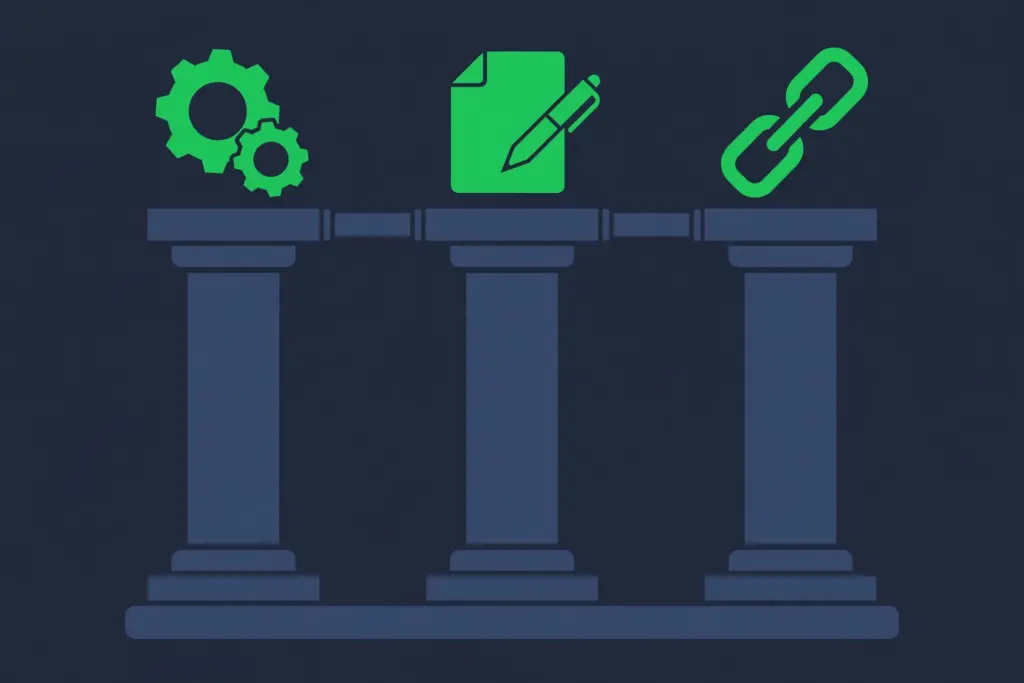
1. Technical SEO: make your site work properly
This is the foundation. Technical SEO ensures Google can crawl, index and understand your site – and that visitors get a fast, smooth experience. It covers page speed (especially mobile), mobile-friendly design, HTTPS, clean site structure, XML sitemaps, and fixing broken links and crawl errors. You can have the best content in the world, but if your site takes eight seconds to load or Google cannot crawl it, you are invisible.
2. Content: answer what people search for
Content is how you earn relevance. Every page on your site is a chance to answer a question your customers are asking Google. This does not mean stuffing keywords – it means understanding search intent and delivering it better than anyone else. That is why we build dedicated SEO pages for Sydney, Melbourne, Brisbane, Perth and Adelaide.
3. Authority: earn the web’s vote of confidence
Google treats links from other websites as votes. When reputable Australian sites link to you, it signals trustworthiness. This is the hardest pillar to build and the easiest to fake badly – buying links can get you penalised. Real authority comes from being worth linking to.
SEO vs Google Ads: what is the difference?
This is the question almost every Australian business owner asks, so let us settle it:
| SEO | Google Ads | |
|---|---|---|
| Cost model | Investment in work; clicks are free | Pay per click, ongoing |
| Speed | 3-6 months to meaningful results | Traffic from day one |
| Durability | Keeps working after you stop paying | Stops the moment you pause spend |
| Trust | Many users skip ads and click organic | Labelled as ads |
Neither is “better” – they do different jobs. Google Ads buys you customers this month. SEO builds you an asset that pays out for years. Most competitive Australian businesses eventually run both. Our Google Ads management and SEO services are designed to work exactly that way.
Why SEO matters specifically for Australian businesses
Australia’s market has quirks that make SEO especially valuable:
- Geography concentrates demand. Most Australians live in a handful of cities, so ranking for “[service] + [city]” captures an outsized share of buyers.
- Competition is thinner than the US or UK. Fewer businesses invest seriously in SEO here, which means competent work goes further, faster.
- Google dominates. The overwhelming majority of Australian searches happen on Google, so one playbook covers nearly the whole market.
- Reviews and maps matter enormously. For local businesses, your Google Business Profile and reviews are half the battle – they are part of local SEO, not separate from it.
How long does SEO take?
The honest answer: 3-6 months to see meaningful movement in competitive Australian markets, with results compounding after that. Less competitive niches and cities can move faster. Anyone promising page one in 30 days is either targeting keywords nobody searches or planning something Google will punish. (We go deeper in our guide to how long SEO takes in Australia.)
How much does SEO cost in Australia?
Australian SEO retainers typically start from around A$1,000/month for small businesses, with competitive Sydney and Melbourne niches often investing A$2,500-A$10,000/month. What matters is what is included and whether the agency ties its work to revenue, not vanity metrics.
Further reading in this cluster:
- How Long Does SEO Take to Work in Australia?
- SEO Consultant Explained: What They Do and When to Hire One
SEO – frequently asked questions
Is SEO still worth it with AI search?
Yes – arguably more. AI Overviews and tools like ChatGPT still draw heavily on content that ranks well and is clearly structured. The fundamentals matter more in an AI-mediated world, not less.
Can I do SEO myself?
The basics, yes: write clear service pages, keep your Google Business Profile updated, ask happy customers for reviews, make sure your site is fast. Competitive markets eventually need professional help, but DIY foundations are never wasted.
What is the difference between SEO and SEM?
SEM (search engine marketing) is the umbrella term covering both SEO and paid search (Google Ads). SEO is the organic half of SEM.
Will SEO work for my industry?
If your customers use Google to find what you sell – and in 2026, that covers nearly every industry in Australia – SEO can work. The strategy differs, but the principles hold.