
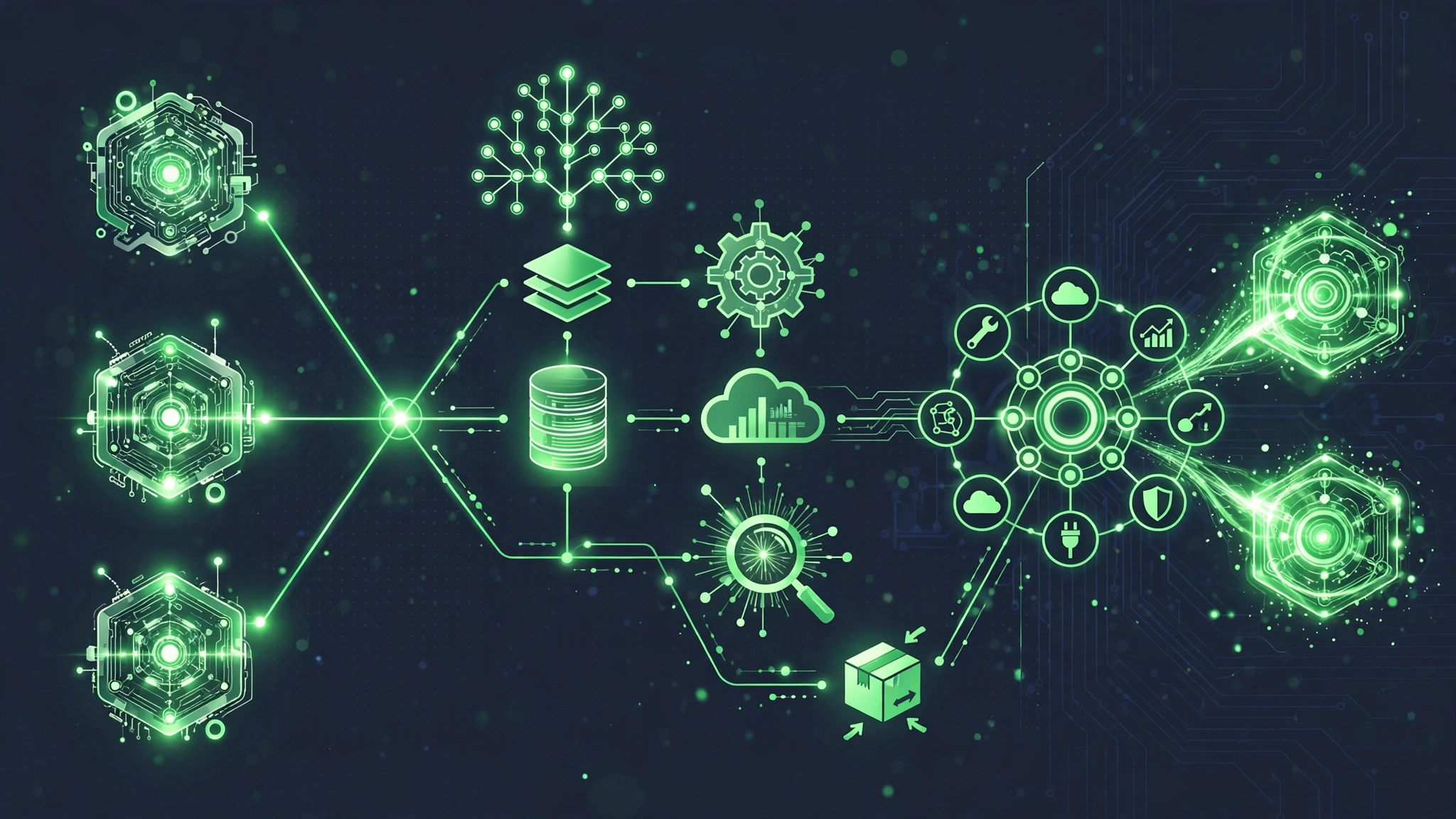
In short: AI agents are autonomous or semi-autonomous systems that complete multi-step business tasks: lead research and enrichment, outreach sequences, data processing, report generation, competitive monitoring. They go beyond chatbots – instead of answering questions, they do work. This 2026 guide explains what AI agents can realistically do for business, the build-vs-buy landscape, guardrails, costs and where to start.
Last updated: October 2026.
Chatbots answer. Agents do. An AI agent takes a goal – “research these 200 prospects and enrich the CRM”, “monitor competitors and summarise weekly changes”, “draft the monthly report from these data sources” – and executes the multi-step work autonomously, asking for human input only at decision points. In 2026, agents moved from demos to deployable – with guardrails, for defined tasks, with measurable output.
What AI agents actually do (realistically)
Research & enrichment. Prospect research, company profiling, data enrichment, list building – the agent browses, extracts and structures data into your CRM or spreadsheet.
Outreach support. Drafting personalised outreach, sequencing follow-ups, qualifying replies – with humans approving sends. (Fully autonomous cold outreach is a spam and reputation risk; keep the human in the loop.)
Monitoring & intelligence. Competitor tracking, price monitoring, review sentiment, news alerts – the agent watches and summarises, you decide.
Data processing. Invoice extraction, document classification, data migration, report assembly – structured output from unstructured input.
Content operations. First-draft generation at scale, repurposing, translation, SEO content pipelines – see SEO automation.
What agents don’t do well yet: genuinely novel judgment, complex negotiation, anything where a mistake is catastrophic without review. Scope agents to tasks where output is verifiable.

Chatbot vs agent vs workflow automation
Chatbots: conversational, reactive, customer-facing. Answer, capture, book.
Agents: goal-directed, proactive, task-executing. Given an objective, they plan steps, use tools, and produce results – often without conversation at all.
Workflow automation: deterministic pipelines (if X then Y). Reliable for known processes; no judgment required.
The power combo: workflows for the predictable, agents for the judgment-heavy steps inside them, chatbots for the human interface. Most serious automation programs use all three.
The guardrail architecture (non-negotiable)
Agents without guardrails are liabilities. Every business agent needs:
1. Defined scope. Exactly what the agent may and may not do – tool permissions, data access boundaries, action limits.
2. Human approval gates. External actions (sending, publishing, spending, deleting) require human sign-off. The agent proposes; the human disposes.
3. Output verification. Spot-check protocols, confidence thresholds, and automatic flagging of anomalous outputs.
4. Audit trails. Every agent action logged: what it did, what data it touched, what it decided. Non-negotiable for compliance and debugging.
5. Kill switches. Instant stop, plus rate limits and budget caps so a runaway agent can’t burn money or reputation.
6. Data governance. What data the agent can read, what it can write, and where outputs go. Customer data needs explicit boundaries.
Build vs buy in 2026
Agent platforms (Relevance AI, Lindy, etc.). Fastest path: pre-built agent templates, managed infrastructure, monthly pricing. Good for standard use cases; limited deep customisation.
Frameworks (LangChain, CrewAI, AutoGen). Build custom agents with code. Maximum control; needs engineering capacity and ongoing maintenance.
n8n + LLM nodes. The pragmatic middle: visual workflow builder with AI agent capabilities, self-hostable, integrates with everything. Our recommended stack for most businesses – see workflow automation.
Agency-built. Done-for-you agent design, guardrails, testing and maintenance. See how to evaluate an AI automation agency.
What do AI agents cost?
Platform subscriptions: AUD $100-$1,000+/month depending on runs and complexity.
Custom agent builds: AUD $5,000-$20,000+ one-off for scoped agents with guardrails, integrations and testing.
LLM usage costs: the hidden line item – agent runs consume tokens. A research agent processing hundreds of prospects monthly can cost hundreds in API fees. Model choice (and prompt efficiency) directly affects the bill.
Maintenance: agents need monitoring, prompt tuning and adaptation as tools/APIs change – budget 15-25% of build cost annually.
ROI framing: price the human hours the agent replaces. A research agent replacing 20 hours/month of VA work at $30/hour = $7,200/year in recovered cost – before quality and speed gains.
Where to start: the first-agent playbook
1. Pick a verifiable task. Output you can check: research lists, summaries, enriched data. Avoid irreversible actions for agent #1.
2. Document the human process. If a person does it in defined steps, an agent can learn it. Vague processes produce vague agents.
3. Start supervised. Human reviews every output initially; approval gates stay on until error rates prove out.
4. Measure against the human baseline. Speed, cost, accuracy vs the manual process. The agent must beat the baseline to earn autonomy.
5. Expand scope gradually. One reliable agent earns the second. Don’t deploy five agents before the first proves itself.
Agents are employees, not magic
Think of AI agents as tireless junior staff: fast, consistent, literal-minded, needing clear instructions and supervision. Managed that way – scoped tasks, guardrails, verification – they’re transformative. Treated as magic, they’re expensive disappointments. The businesses winning with agents in 2026 aren’t the ones with the fanciest models; they’re the ones with the clearest processes.
At Vans Marketing, we deploy agents where the ROI is provable and the guardrails are real. Get a free audit and we’ll identify the highest-ROI first agent for your business.
AI agents for business – frequently asked questions
What is an AI agent for business?
An AI agent is a goal-directed system that completes multi-step business tasks autonomously: research, enrichment, monitoring, data processing, draft generation. Unlike chatbots (which converse), agents execute work – planning steps, using tools, and producing verifiable output.
What’s the difference between AI agents and chatbots?
Chatbots are conversational and reactive – they answer questions within a defined scope. Agents are goal-directed and proactive – given an objective, they plan and execute multi-step tasks, often without any conversation. See our chatbots guide for the customer-facing side.
How much do AI agents cost?
Platform subscriptions: AUD $100-$1,000+/month. Custom builds: $5,000-$20,000+. LLM usage fees scale with runs. Maintenance: ~15-25% of build cost annually. ROI typically comes from replaced human hours on verifiable tasks.
Are AI agents safe for business use?
With proper guardrails: defined scope, human approval gates on external actions, output verification, audit trails, kill switches and data governance – yes. Without them, agents are liabilities. Never deploy unsupervised agents on irreversible actions.
What should my first AI agent do?
A verifiable, reversible task with clear steps: prospect research, competitor monitoring summaries, data enrichment, report assembly. Start supervised with human review, measure against the human baseline, and expand only after reliability is proven.